Choosing a marking technology for high-volume manufacturing
Choosing the right marking or printing technology can be challenging because its suitability depends strongly on the use case. For small series, quick artwork changes and limited tooling may carry the most weight. In high-volume manufacturing, cycle time, consistent quality and the amount of operator intervention become more influential.
The decision also needs to accommodate a changing product portfolio. A process selected for one device may later need to handle different lengths, materials, colors or artwork. Digital artwork changes offer flexibility, but a new variant can still require different tooling, additional processing time or a new material assessment.
Laser marking, dry offset, inkjet and pad printing each offer useful capabilities. The practical question is which approach can produce the required artwork consistently, at the required output, across the intended product range.
Different priorities lead to different choices
| Technology | Main attraction | What needs attention at high volume |
|---|---|---|
| Laser marking | Electronic artwork changes and identification without printing ink | Exposure time, material response, coverage and product positioning |
| UV dry offset | Repetitive circumferential artwork, several colors transferred in one impression, and no evaporating solvents in the UV ink system | Product support, synchronized rotation, tooling changes and curing |
| Inkjet | Variable artwork and multicolor printing without printing plates | Printhead coverage, stitching, surface condition, nozzle maintenance and curing |
| Pad printing | Local artwork on curved or irregular surfaces | Solvent handling, ink mixing and viscosity control, pad motion, drying and parallel processing |
These differences become more significant as the artwork grows or additional product variants enter production. A new file may be straightforward to load, while its effect on the production cycle requires a separate assessment.
When artwork determines the laser cycle
Laser marking builds an image progressively. The beam traces lines and fills solid areas with closely spaced scan paths. Marking time therefore depends on the actual artwork, the exposure required to achieve contrast and the number of passes.
When the artwork extends around the outside diameter and along the device’s length, both coverage and access become important. The laser must reach each region and deliver sufficient energy throughout the image. Dense artwork can occupy enough processing time to become the limiting operation in an otherwise fast assembly line.
The distinction between image dimensions and marked area matters. A few graduation lines distributed over a long barrel require a different amount of work from a filled graphic across the same dimensions. Specifying diameter and print length alone is insufficient to establish the marking time.
Dry offset transfers prepared artwork through rolling contact between the blanket and the product. It does not trace each individual feature with a beam. This makes it an important comparison for repetitive circumferential artwork at high volume. Its production rate still depends on feeding, rotation, ink transfer, curing and inspection.
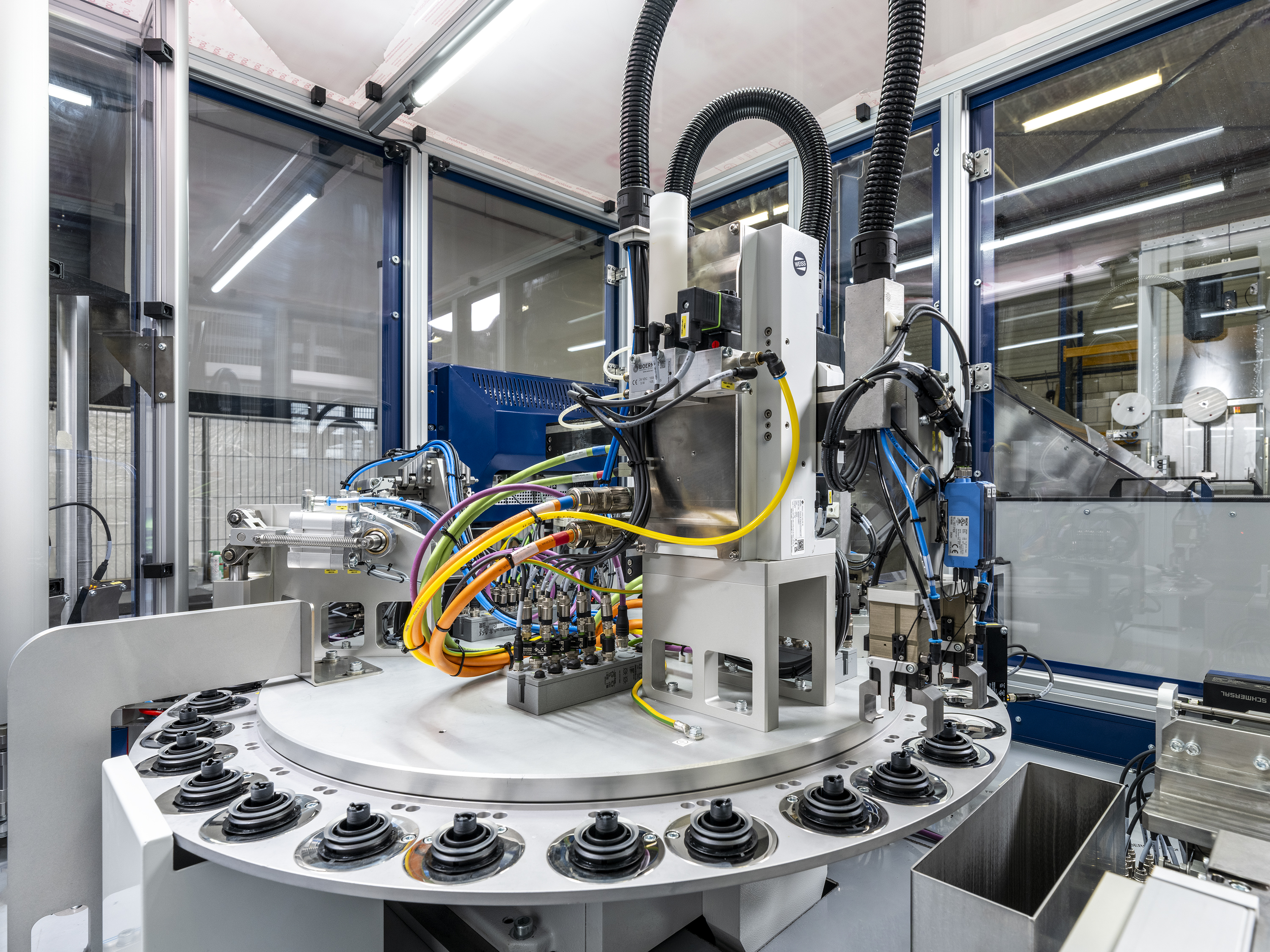
For laser marking, the complete cycle must include product positioning and any required motion, as well as exposure. A fast scanner specification alone does not establish the number of acceptable devices produced per minute.
Reaching the full circumference
Two arrangements deserve consideration when the artwork extends around the device.
The first concept places multiple lasers around the circumference, with each assigned a portion of the artwork. The design assessment should establish whether the fields provide complete coverage, whether the heads can operate simultaneously and how the artwork joins between fields. Coverage along the device’s length also needs checking. Adding heads around the circumference does not automatically resolve a marking field that is too short.
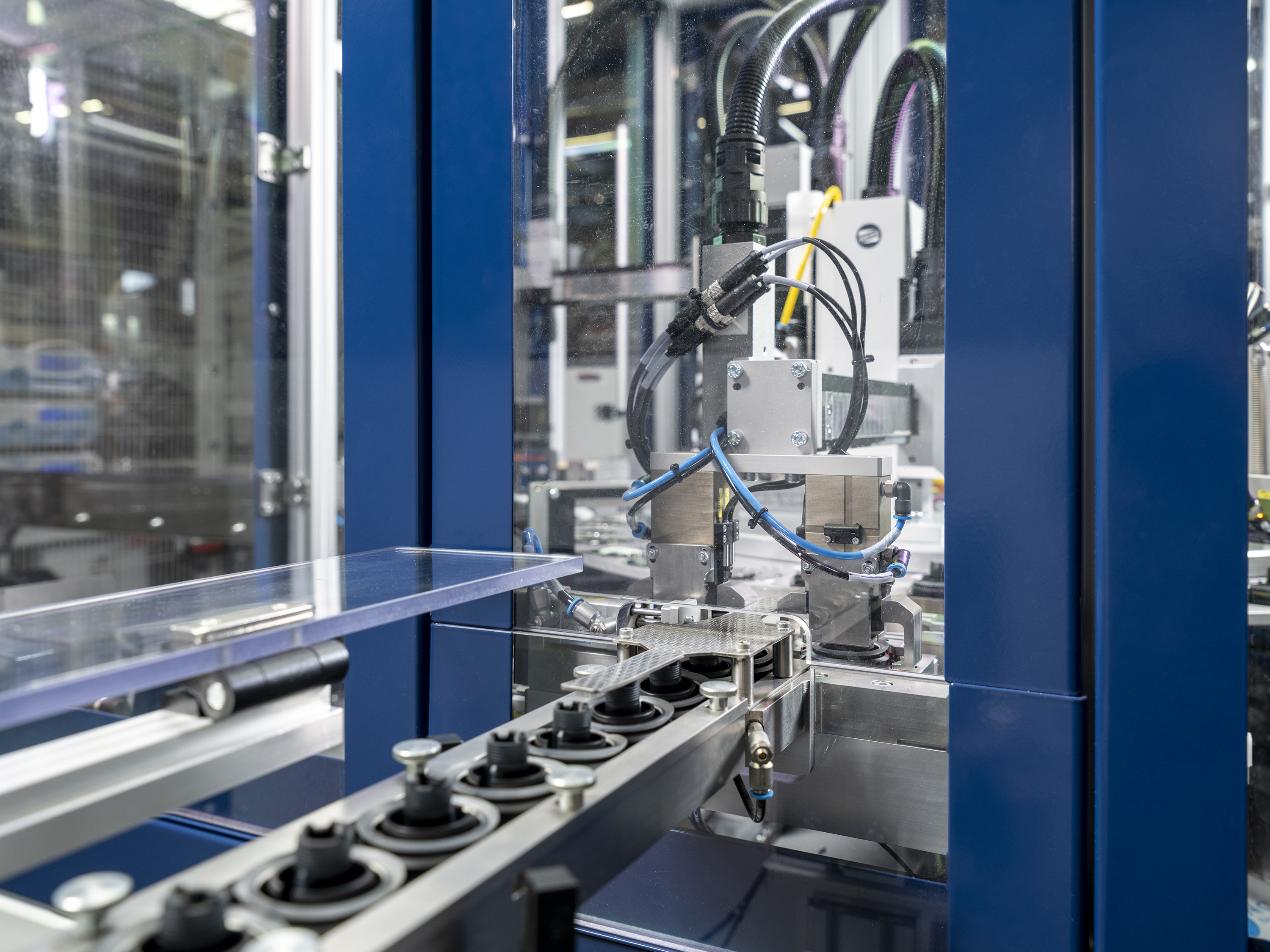
The second approach uses a controlled rotary axis, often called a fourth axis, to turn the device in front of the laser. Successive regions enter the marking field as the product rotates. The artwork can be divided into sections, or marking can be synchronized with continuous rotation.
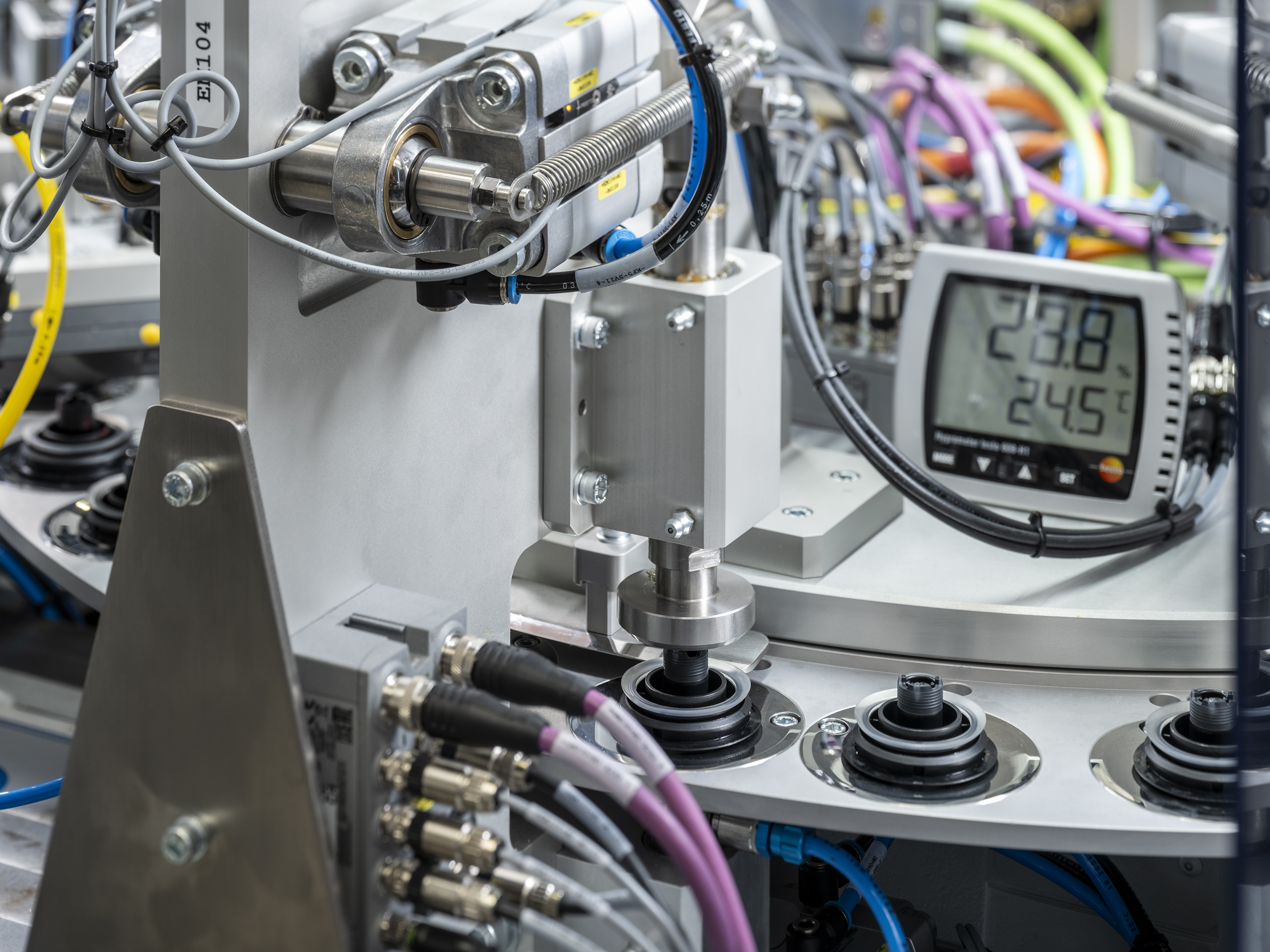
Rotary marking requires the correct radius, repeatable positioning and accurate synchronization. Slip can distort the image, while joins between sections can affect the spacing of text and graduation lines.
For either arrangement, the development review should include vibration during exposure and its potential effect on artwork accuracy. Mark quality needs to be assessed with the surrounding automation operating at production speed. Any positioning or settling allowance must be included in the available process time.
Contrast depends on material and exposure
Laser marking generally creates contrast by changing the material itself. The formulation of the plastic granulate therefore plays a direct role in the result. Base polymer, pigments, fillers and laser-sensitive additives can influence how the material absorbs the selected wavelength and what visible change occurs.
Exposure time and laser settings must match that response. Slower scanning or additional passes can change the contrast, but also increase processing time. Pulse energy, pulse duration, repetition rate and focus influence the result alongside average power.
Increasing energy is not a universal remedy for a weak mark. A poorly matched material and wavelength can produce melting, bubbles or other unwanted changes before achieving sufficient contrast.
Laser-sensitive additives, incorporated through a masterbatch or formulated compound, can improve the response of a plastic that otherwise marks poorly. Their suitability must be checked on the actual product. An additive can affect transparency or other material properties, so its introduction is a material change rather than a simple adjustment to the machine.
This connects contrast directly to manufacturing capacity: the relevant result is the required mark quality at an exposure time the production system can accommodate.

Inkjet: flexibility within a defined print width
Inkjet offers electronic artwork changes and multicolor printing without plates. For a growing portfolio, this can simplify changes between images. Product geometry and printhead coverage still determine how those images can be applied.
If the artwork extends beyond the active nozzle-array length across the printing direction, a single stationary head cannot cover it in one pass. With that head size, adjacent heads or successive print swaths must be stitched together. Their alignment and overlap require control to avoid visible bands, gaps or doubled features. A longer image in the direction of product travel does not, by itself, require additional heads.
On a cylindrical device, the arrangement must also provide the required circumferential coverage. Additional movements or rotations extend processing time; multiple heads increase the equipment and alignment requirements.
Inkjet image formation is sensitive to local surface condition because individual droplets must wet and spread consistently. Differences in surface energy or contamination can leave areas with incomplete coverage and a weaker appearance. Excessive spreading can make edges look blurred. Uniform pretreatment, suitable ink and controlled timing before UV pinning are therefore important to consistent image quality.
White ink can improve contrast on dark or transparent products. Additional layers, however, bring extra deposition and curing requirements, and may require further passes.
Comparing contrast and production consistency
Ink-based technologies offer more freedom to select the final color than laser marking. Dry offset and pad printing use selected ink colors; inkjet provides digital color reproduction and, where configured, a white underlayer.
That freedom does not guarantee sufficient opacity in one impression. Dry offset and pad printing typically apply relatively thin films. Dark or transparent products may require an underprint or repeated impression, with consequences for stations, registration and processing time.
UV dry offset also offers an operational advantage: the UV ink system does not use evaporating solvents to achieve transfer. The ink remains workable until exposed to the appropriate UV energy, avoiding viscosity changes caused by solvent evaporation. Many formulations are supplied ready for use, although spot colors may still require controlled mixing. Ink temperature, roller settings and curing remain important process controls.
Conventional pad printing generally uses solvent-based inks. Ink preparation requires controlled mixing of ink and thinner, plus hardener for two-component systems. Solvent evaporation changes viscosity during production, while two-component inks also have a limited pot life. These factors introduce preparation, monitoring and replenishment tasks that matter during extended production runs.
Pad printing is particularly useful for local markings on curved or irregular surfaces. For high output, several products can be printed in parallel. The required pad movements, ink pickup and release remain part of the cycle, while large images can introduce additional deformation and transfer challenges.
There is no universal contrast ranking among these technologies. The useful comparison is the finished artwork on the actual product, at the required production speed. It should include edge definition and readability, together with resistance to the handling, chemicals and other exposures relevant to the application.
AAE selects and integrates printing processes according to the product and production requirements, with sample printing available to compare technologies and settings. For extensive device artwork, the initial decision should connect the required contrast to the time and machine arrangement needed to produce it consistently.
Share your marking application with us. If available, the artwork, product dimensions, resin grade and target output provide a useful starting point for discussing laser marking, dry offset, inkjet or pad printing. Include anticipated product variants so the discussion addresses both the first application and the portfolio that may follow.